Thursday, November 6, 2014

부동산 현금구매 전체 구매의 3분의 1 로 감소

작년대비 올해 투자자의 부동산 구매비율 감소
( reatytrac  자료에따르면 최근 분기 판매실적을 근거로   residential home sales 의 4.3% 만 투자자거래 : 작년 동일 분기의 10% 대비 ... 감소 )
 
cash sales 는 2분기 36.9 % 에서 3 분기 33.9% 로 감소
 
자세한 내용은 아래 참조...
 
부동산회사 : 1 GOOD GUY     www.1goodguy.com
융자회사    : 1 KB LOAN        www.1kbloan.com
김 기범 : BROKER / OWNER
연락처 : 951-271-1922
 
 
Cash Sales Decline: Now 'only' 1 in 3 Homes; Metro Price Increases Moderate
Institutional investor participation in the single family residential market fell another notch in the third quarter of 2014.  RealtyTrac said today that only 4.3 percent of residential sales in the most recently completed quarter went to those investors, defined as those who purchase 10 or more properties in a calendar year.  This group was responsible for purchases of 5.0 percent of single family homes and condos in the second quarter and 5.3 percent in the third quarter of 2013.  The recent results were the smallest since the fourth quarter of 2010. 
The number of transactions that were all cash also declined, from 36.9 percent in the second quarter to 33.9 percent in the third.  The all-cash percentage was unchanged from the third quarter of 2013.
"Cash sales continue to be an important piece of the real estate puzzle right now, representing one in every three home sales nationwide in the third quarter of 2014 and helping to drive up U.S. median home prices 38 percent over the last two and half years," said Daren Blomquist, vice president at RealtyTrac. "As institutional investors and other cash buyers slow down their purchasing in many markets across the country, more traditional buyers - including first-time homebuyers and move-up buyers - will need to increasingly fill in the missing puzzle pieces to maintain the momentum of the housing recovery.
Blomquist said that while institutional investors are still actively in the market they are tending to gravitate to areas where there is still low-end inventory available.  He noted that some markets have seen a recent surge in cash transactions and these often coincided with either a rebound in distressed sales or a booming job market creating a competitive bidding environment where cash gives buyers an edge.
Cash sales in the third quarter skewed higher on both ends of the home price spectrum. Cash sales accounted for 64 percent of purchases of homes selling for $100,000 or less, and for 41 percent of purchases of homes selling for more than $2 million.  Cash sales also dominated in the distressed home market accounting for 54.6 percent of REO and short sales.
In other housing news the National Association of Realtors® (NAR) reported that home prices were up during the third quarter in most of the county's major metropolitan areas.  Median prices of existing single-family homes increased in 125 or 73 percent of the 172 areas tracked by NAR.  Forty-seven areas or 27 percent saw median prices slip from a year ago. During the second quarter there were median price increases in 71 percent of metro areas.  NAR's data is based on transactions that closed during the quarter.
While prices were still rising NAR said that only 16 metros or 9 percent had percentage price increases in the double digit range in the third quarter compared to 54 areas or 33 percent during the third quarter of 2013 and nineteen areas in the second quarter of this year. 
Lawrence Yun, NAR chief economist, says home prices in the third quarter continued to stabilize towards a healthier rate of growth. "Home-price gains returned to more normalized levels of low- to mid-single digit rate of appreciation in many metro markets as inventory levels steadily increased," he said. "Moreover, there are a good number of local markets that are still remarkably affordable with median prices at or under $200,000."
Yun adds, "Given the improving labor market and historically low interest rates, more buyers are anticipated to enter the market next year."
NAR looked at metro area condominium and cooperative prices in 61 metro areas and found 41 (67 percent) had increased from a year ago while 20 areas declined.  Based on those areas NAR said the national median existing condo price was $211,000 in the third quarter, 2.7 percent higher than a year ago when the median was $205,000.  The national median existing single-family home price in the third quarter was $217,300, up 4.9 percent from the third quarter of 2013 ($207,100). The median price during the second quarter of 2014 increased 4.2 percent year-over-year.

Monday, July 21, 2014

부동산 가격 앞으로 2 년이내에 최고가도달 후 하락 예상

 
앞으로 2년 동안은 가격의 점진적인 상승을 예상하며 , 향후에는 가격이 하락 or 조정 국면에 들어갈 것으로 예상
앞으로 2년간 점진적인 가격 상승예상은
                    미국내 실업률의 점진적인 하락 및
                     국채 소득율  2 YEAR / 10 YEAR 의 낮음
                     LOW INFLARION RATE
 
기타 세부 적인 사항은 아래 자료 참조
MORTGAGE BROKER / OWNER
1 KB LOAN
CORNA CA 92881
License: DRE BROKER LIC. : 01872489 ...
Send Me an Email | (951) 271-1922
Home Prices to Level Off and Reverse Course Within 2 Years - Analysts
Two Bank of America Merrill Lynch (BAML) analysts are defending what they call their big high conviction views for what should happen in the housing world over the next two years.    Chris Flanagan and Gregory Fitter, ABS and MBS strategists say that their views are not mainstream but that recent data has corroborated their theories. 
The two contend that home price increases will continue to moderate from the skyrocket trajectory they were on in late 2012 and early 2013 will peak in mid-2016.  Second, as unemployment continues to ease, the yield curve will continue to flatten (longer term rates getting lower while shorter term rates get higher, relative to each other) and the spread between two year and 10 year treasury yields should be at zero by the time home prices peak.  The long end of the curve will remain at surprising low yields, fostered by a soft housing market and low inflation.  
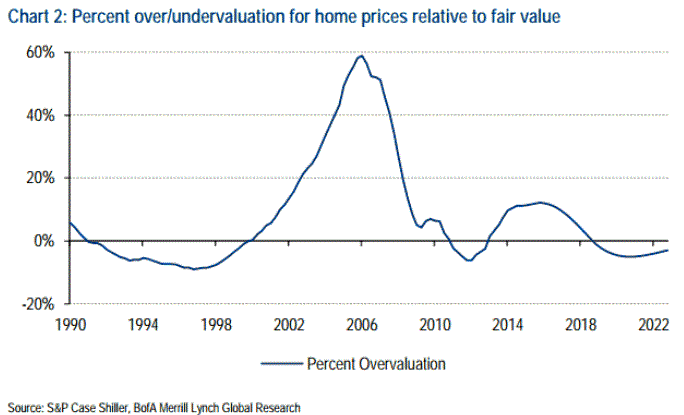
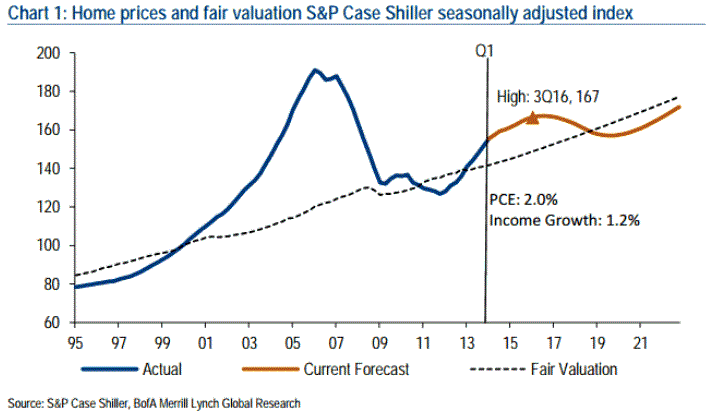
The first "big view", that home prices will peak in two years is validated they say by the most recent income based home price model from Case Shiller.  Charts 1 and 2 includes the Case Shiller historical and forecasted home price index (HPI) along with the BoA strategists' estimate of fair value.  This model shows that the HPI will increase from the first quarter 2014 level of 155.5 to a peak of 167.3 in the third quarter of 2016.  This is an annualized growth of 3 percent over 30 months compared to 11 percent in 2013 and the 9.5 percent annualized rate since prices bottomed in the fourth quarter of 2011. Then prices are expected to decline and not recover to the 2016 level until Q2 2022, an annualized rate of price growth over six years of 0.  With this factored in, the annualized home price growth rate between Q1 2014 and Q2 2022 is expected to be 1.0 percent.


The authors estimate that the Case-Shiller HPI was already 9.7 percent over valued in the first quarter of this year when compared to the author's fair value estimate and that it was 6.2 percent undervalued when it hit bottom in 2011, a 16 percent swing in valuation in two  years.  The last time such a rate of acceleration was observed was in 2002, the beginning of the housing bubble.  The author's model projects that prices will be overvalued by 12 percent late next year or early in 2016 and this will eventually lead prices to fall, probably below fair value.


The projected reversion to fair value mirrors what happened before, during, and after the housing crisis, but at a lower level of reevaluation.  During the early 2000s housing boom overvaluation peaked in Q1 2006 at 58.9 percent before prices declined by 34 percent, overshooting fair value at the bottom end.  It will be very different this time, primarily due to the regulatory framework, most notably Dodd-Frank, which has been put in place in response to that boom and bust.  After peaking this time, they expect prices to remain flat or unchanged for six years, not plummet as happened ten years before; exactly what the regulatory framework was meant to do.  "From that perspective," they say, "0% home price growth from 2016-2022 seems to us to be a fantastic outcome and exactly what policymakers had hoped for when establishing the new regulatory framework."
Given this scenario the authors ask what the catalyst might be for increasing interest rates.  If anything, they way, even lower rates seem more plausible; "it is difficult for us to see what generates any meaningful, sustainable increase in interest rate volatility."
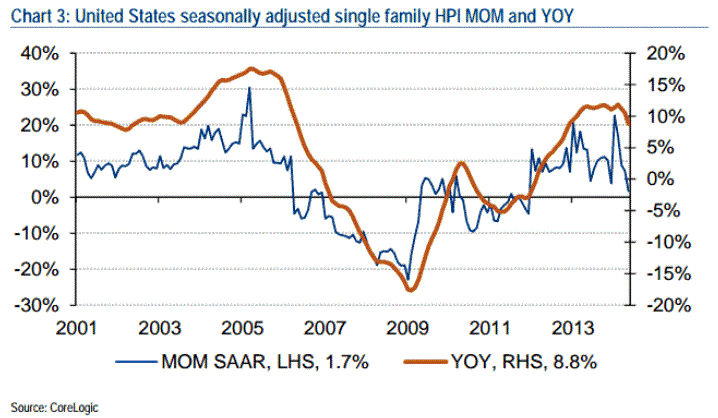
The authors also cite the May CoreLogic report issued in early July as further substantiation of their theory of slowing price growth.  CoreLogic, with data more recent than that provided by Case-Shiller, shows year-over-year (YOY) home price growth for May of 8.8 percent, down 3 percentage points from February's 11.8 percent which the authors believe will prove to be the cyclical peak.  Annual growth of 11.5 percent had persisted since early 2013.  The decline from the February "peak" started in March and accelerated to the downside in May. 
Likewise, the annualized month-over-month (MOM) data slowed temporarily after mortgage rates went up in mid-2013 from the 20 percent level early in the year.  While January and February 2014 were exceptionally strong at rates of 26.0 and 16 percent respectively growth then began to slow.  MOM data for May showed an increase of 1.7 percent following 2.4 percent in April.  Flanagan and Fitter said that CoreLogic's April and May readings suggest that their own model calling for a 3 percent rate of price growth for 2.5 years followed by 1 percent for the next eight years is beginning to be realized.


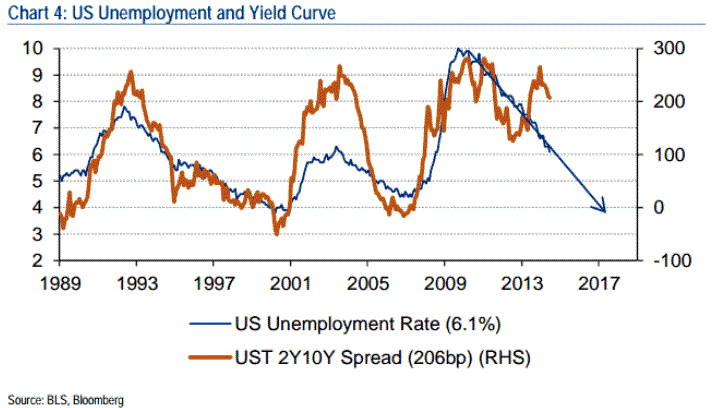
Their second view that massive yield curve flattening began with the new year and will continue until the 2 and 10 year spreads hit zero in 2016 is bolstered by the most recent unemployment report.  Chart 4 shows their view of the relationship between unemployment and the two yield curve spreads.  The unemployment rate has been declining in a fairly linear manner since the peak in October 2009.  Extrapolating the decline forward, they estimate that unemployment will hit 5 percent in 2015 and 4 percent in early 2017.  Historically it has not been long after unemployment drops below 5 percent that the 2 and 10 year spreads approach or drop below zero.


The analysts concede Fed Chairperson Janet Yellen's concerns about labor market slack could mean it will be different this time, but they hold to their theory; that declining unemployment will force the Fed to act and those zero rates will be obtained on the schedule they project.

Friday, July 18, 2014

은행 FORECLOSURE 매물 숫자 관련 중요한 시점

2006 년 집 가격 하락 이후 미국 전체 가장 낮은 숫자의 FORECLOSURE RATE 을 보임.
작년 전반기 대비 약 19% 의 FORECLOSURE  감소 및 후반기 대비 23% 감소를 보여왔으며 , 앞으로 는  급격한 FORECLOSURE 감소보다는 FLAT 한 수전에서 FORECLOSURE 를 나타낼것으로 보임 ( 이미 2006 년 대비 FORECLOSURE RATE 이 낮게 나타남 )
아래 연도별 FORECLOSURE RATE TABLE 참조
 
아래내용 세부 주별 FORECLOSURE RATE 감소 지역과 증가 지역 관련 내용 참조


Foreclosures hit Important Milestone; Concerning Trends in Some States
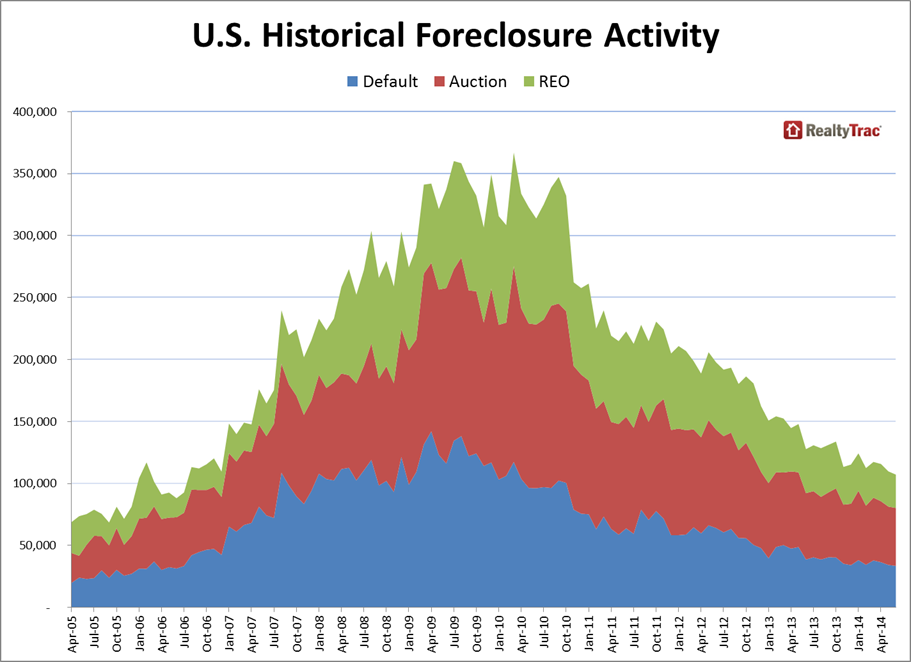
It has been a long eight years, but foreclosure activity appears to have returned to levels last seen before the housing downturn was born in 2006.  RealtyTrac said today that the 2 percent decrease in the various types of foreclosure filings in June brought overall activity down to the lowest it has been since July of that year.  The company released its Midyear Foreclosure Market Report which contains data on both June foreclosure filings and those that occurred during the first half of 2014.
June filings, including default notices, scheduled auctions, and bank repossessions or completed foreclosures, were filed on a total of 107,194 properties, down 2 percent from May and 16 percent from June 2013.  For the first half of the year there were 613,874 filings, a decrease of 19 percent from the last half of 2013 and 23 percent from the first six months of that year.  Filings at mid-year equate to one filing for every 214 housing units in the U.S.
"Nationwide foreclosure activity in June reached an important milestone, dropping to levels not seen since before the housing price bubble burst in August 2006," said Daren Blomquist, vice president at RealtyTrac. "Over the next six to nine months nationwide foreclosure numbers should start to flat line at consistently historically normal levels.


Ten states also were at the lowest level of foreclosure activity in June since the housing bubble burst in August 2006.  These include Texas, Georgia, Colorado, Tennessee, Arizona and Nevada.  Activity was down during the first half of the year compared to the first six months of 2013 in all but nine states.  Among those with the larger increases were New Jersey which was up 54 percent, Maryland (+18 percent), Iowa (+10 percent), and Massachusetts and Connecticut, each with 4 percent increases.
Overall foreclosure rates during the first half of the year were highest in Florida with one filing for every 74 housing units, Maryland with one in 107, Illinois, one in 123; New Jersey, one in 134; and Nevada, one in 138.
There were 47,243 first-time foreclosure starts in June, down 4 percent from May and 18 percent from a year earlier and the lowest number since November 2005.  Foreclosure starts for the first six months numbered 315,895.  At the current pace foreclosure starts will probably exceed 630,000 by the end of the year compared to a finally tally of 747,728 for all of 2013.
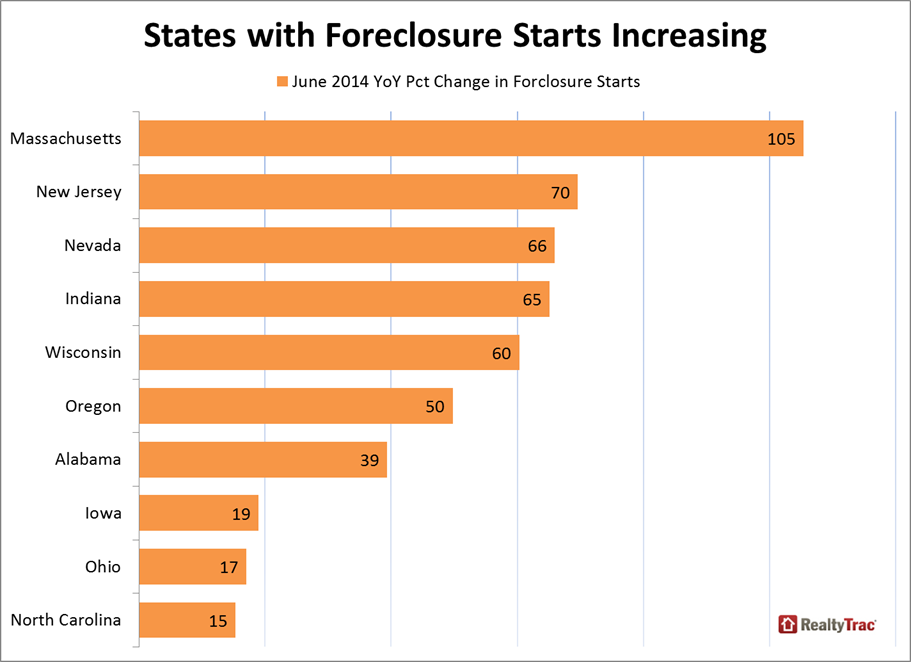
Foreclosure starts in June increased from the previous month in 15 states and were up from a year ago in 20 states.  States will large annual increase include Massachusetts (+105 percent), New Jersey (+70 percent), Nevada and Indiana (+65 percent), and Oregon (+50 percent).


There were 26,889 completed foreclosures in June and 174,691 during the first six months of the year.  June's foreclosures were down 5 percent from May and 24 percent from June 2013 and represented an 84 month low.  Based on the midyear number RealtyTrac estimates there will be 350,000 foreclosures this year, down from 462,970 in all of 2013.
Completed foreclosures in June were higher than in May in 16 states and higher than a year ago in 12.  Both Iowa and Maryland had 86 percent more foreclosures in June than a year earlier, New York was up 49 percent and Oregon 22 percent. 
Foreclosure auctions were scheduled for the first time on 46,743 U.S. properties in June, 1 percent fewer than in May and down 13 percent from a year ago to the lowest level since July 2006 - a 95-month low.  Scheduled auctions increased from May in 12 states and from a year ago in 17 with the largest increases of 68 percent and 62 percent respectively in Connecticut and Pennsylvania.
"There continue to be concerning trends in some states and local markets that clearly indicate those markets are not completely out of the woods when it comes to the lingering foreclosure problem left over from the housing bust," Blomquist said. "While it's important that any remaining foreclosure infection is addressed promptly to keep it from festering, foreclosures are no longer a widespread contagion threatening to derail the housing market's return to full health."


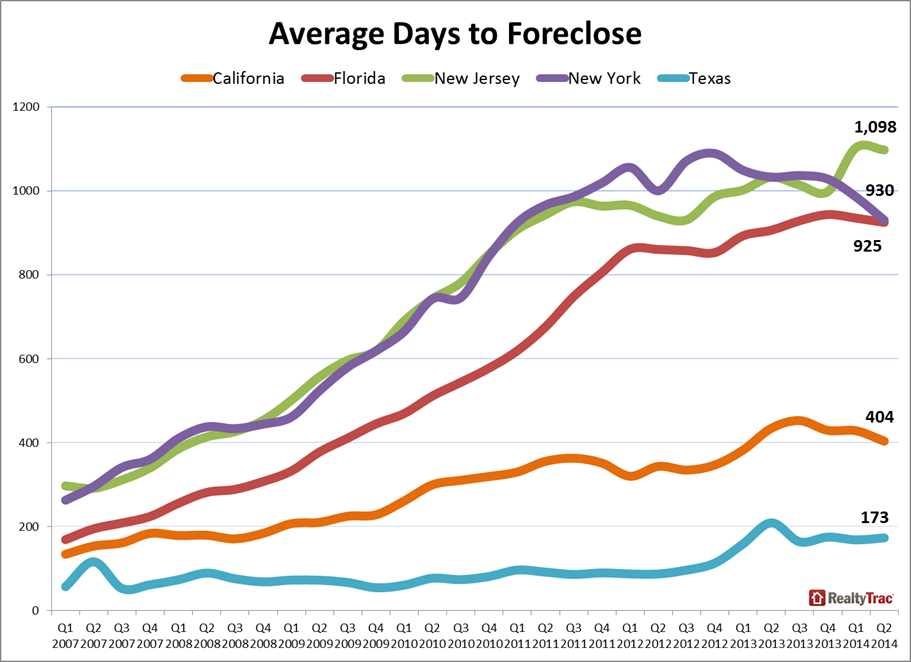
Despite dwindling numbers of foreclosure filings the timeline to complete a foreclosure continues to lengthen.  The average time to complete a foreclosure in the second quarter of 2014 was 577 days, up from 572 days in the first quarter and 526 days in the second quarter of 2013 while in New Jersey it currently takes nearly twice as long, an average of 1,098 days.  The process is also extremely lengthy in New York (930 days), Hawaii (915 days), Illinois (850 days) and Massachusetts (784 days.

Wednesday, May 7, 2014

6개월 만에 모게지 이자율 최저

부동산시장이 1년중 바쁜 성수기에 접어들면서 , 그동안 올랐던 이자율도
6개월 만에 최저치를 기록하며 , 올한해에도  이자율의 상승에 대한 두려움으로
위축될수 있는 부동산구매수요를 희석시키기위하여 ,
또한 현재 부동산가격상승폭의 조정및 점진적 상승을 위하여 이자율이 낮아짐에따라
부동산에 실 수요자 위주의 꾸준한 유입이 예상 됩니다.
아래내요은 모게지 이자율이 최근 6개월 치 중에서 5월 7일 이 가장 낮다는 내용이며,
세부적인 자료는 아래 참조 하세요.
 
 
Mortgage Rates Push Further Into 6-Month Lows
Mortgage rates continued pushing into the lowest levels in more than 6 months after a docile congressional testimony from Fed Chair Yellen this morning.  Financial markets and mortgage lenders were cautious ahead of the 10am speech, but improved afterward.  A majority of lenders issued mid-day reprices, bringing rate sheets to levels not seen since November 1st.  The most prevalently quoted conforming 30yr fixed rate for best-case scenarios (best-execution) is already straddling 4.25% and 4.125%.  Today's improvement equates to an effective drop of 0.04%.
Today's strength means that rates are now officially "testing" a break below the longer term range--a range that has remained intact since the beginning of February.  Of course we're already below that range today, but when it comes to looking for bigger-picture shifts in the trend, we're looking for a certain combination of TIME spent outside the trend and DISTANCE between the edge of the trend and current levels.
If we were only looking at mortgage rates, the combination of time spent under the 2014 range and the distance below the previous lows is looking pretty promising.  If we look elsewhere, however, to some of the other factors that can impact mortgage rate momentum, it still makes sense to be cautious.  One of the factors is the situation in Ukraine that's thought to be keeping some extra downward pressure on interest rates in the US.
The other consideration is that the Treasury market, which is a very close companion for mortgage rates, hasn't quite shown the same desire to break its own range, and that's something we'd need to see in order to have more confidence in a more pronounced move lower.  That's not to say it can't happen, simply that where mortgage rates seem rather convinced, the broader market for interest rates isn't quite there yet.
Loan Originator Perspectives
"It appears rates are trying to make a move and break out of the current range that has existed all year. Much of the improvement is due to the geopolitical risk that Ukraine is creating which could unwind quickly and unexpectedly which makes floating risky. Tomorrow we get our last treasury auction for the week, and it isn't uncommon for rates to rally after the new supply has been absorbed by the markets. At this point, I think floating is the way to go." -Victor Burek, Open Mortgage
"LOCK---The 10 year auction today went well, but it wasn't a barn burner and we still set at the bottom of the range. There's no data scheduled tomorrow or Friday that is viewed with enough importance to help us break lower. The greatest risk is to the upside right now, protect your gains & lock. " -Brent Borcherding, www.brentborcherding.com
"Continued small improvements like today are quite nice but we still seem to have resistance to a convincing break through this range we've been stuck in. As we continue to bounce along the bottom of the range I would remain cautious. I still favor locking these rates in now and especially for closings within 30 days." -Hugh W. Page, Sen. Mortgage Consultant, M.B.A. Capital Partners Mortgage
"Rates dropped today for both US bonds and mortgages as we moved further into the best pricing of the year. While we haven't definitively broken our prior range, we're still trending downward. Comments from the Fed, Ukrainian Drama, and a decent treasury auction all helped, nice break for buyers and borrowers!" -Ted Rood, Senior Mortgage Planner, tedroodteam.com
"Best rates of the year and potential for further improvement. Locking always safe, but floating has paid off the last few weeks. If bonds can break below the floor in place all year and stay there for a few days, it would be a positive development. " -Michael Owens, VP of Mortgage Lending at Guaranteed Rate, Inc.
Today's Best-Execution Rates

Thursday, April 24, 2014

2014 년 3월 california 부동산 판매 및 가격 현황

전체적으로 2014년 2월 대비 3월 역시 가격의 증가 추세를 유지 하고 있습니다
 
March 2014

County Sales & Price Report
  (pdf file
 
)

SALES AND PRICE ACTIVITY
Regional/County Sales Data and Condo Sales Data Not Seasonally Adjusted
 
March-14
Median Sold Price of Existing Single-Family Homes
Sales
State/Region/County
Mar-14
Feb-14
 
Mar-13
 
MTM% Chg
YTY% Chg
MTM% Chg
YTY% Chg
CA SFH (SAAR)
$435,470
$404,250
 
$379,000
r
7.7%
14.9%
1.4%
-12.3%
CA Condo/Townhomes
$360,830
$345,430
 
$306,000
r
4.5%
17.9%
25.8%
-6.1%
Los Angeles Metropolitan Area
$402,030
$383,300
 
$353,350
r
4.9%
13.8%
23.6%
-15.5%
Inland Empire
$271,250
$260,380
 
$227,920
 
4.2%
19.0%
22.0%
-11.0%
S.F. Bay Area
$724,590
$675,000
 
$636,150
 
7.3%
13.9%
36.1%
-10.5%


S.F. Bay Area
Mar-14
Feb-14
 
Mar-13
 
MTM% Chg
YTY% Chg
MTM% Chg
YTY% Chg
Alameda
$660,610
$627,550
 
$578,310
 
5.3%
14.2%
51.3%
-13.0%
Contra-Costa (Central County)
$703,490
$629,570
 
$721,870
 
11.7%
-2.5%
25.2%
14.1%
Marin
$1,039,770
$983,700
r
$888,890
 
5.7%
17.0%
58.1%
-3.6%
Napa
$585,530
$466,670
 
$430,950
 
25.5%
35.9%
10.6%
-27.7%
San Francisco
$902,540
$964,670
 
$828,700
 
-6.4%
8.9%
22.3%
-14.5%
San Mateo
$1,164,750
$965,000
 
$912,000
 
20.7%
27.7%
51.6%
-12.6%
Santa Clara
$852,000
$801,000
 
$730,000
 
6.4%
16.7%
39.2%
-11.8%
Solano
$312,350
$288,300
 
$250,000
 
8.3%
24.9%
19.4%
-21.3%
Sonoma
$494,180
$467,860
 
$398,090
 
5.6%
24.1%
34.1%
-12.0%
Southern California
Mar-14
Feb-14
 
Mar-13
 
MTM% Chg
YTY% Chg
MTM% Chg
YTY% Chg
Los Angeles
$395,780
$389,080
 
$340,890
 
1.7%
16.1%
20.4%
-17.1%
Orange County
$675,540
$677,700
 
$619,430
 
-0.3%
9.1%
36.1%
-17.6%
Riverside County
$310,670
$302,370
 
$263,670
 
2.7%
17.8%
26.2%
-8.3%
San Bernardino
$188,800
$185,590
 
$161,900
 
1.7%
16.6%
14.3%
-16.0%
San Diego
$490,280
$476,780
 
$436,710
 
2.8%
12.3%
32.3%
-15.1%
Ventura
$559,320
$558,490
 
$475,000
 
0.1%
17.8%
22.2%
-25.4%
Central Coast
Mar-14
Feb-14
 
Mar-13
 
MTM% Chg
YTY% Chg
MTM% Chg
YTY% Chg
Monterey
$517,500
$500,000
 
$359,900
 
3.5%
43.8%
11.6%
-40.7%
San Luis Obispo
$491,340
$480,680
 
$417,590
 
2.2%
17.7%
22.2%
-20.5%
Santa Barbara
$605,470
$661,760
 
$575,000
r
-8.5%
5.3%
33.6%
-20.9%
Santa Cruz
$635,000
$600,000
 
$585,000
 
5.8%
8.5%
5.5%
-29.4%
Central Valley
Mar-14
Feb-14
 
Mar-13
 
MTM% Chg
YTY% Chg
MTM% Chg
YTY% Chg
Fresno
$202,100
$182,270
 
$160,510
 
10.9%
25.9%
16.6%
-19.1%
Glenn
$140,000
$200,000
 
$130,000
 
-30.0%
7.7%
0.0%
-38.5%
Kern (Bakersfield)
$200,000
$195,000
r
$175,000
r
2.6%
14.3%
22.6%
-10.5%
Kings County
$179,230
$182,500
 
$146,000
 
-1.8%
22.8%
38.6%
-4.8%
Madera
$190,000
$147,500
 
$136,000
 
28.8%
39.7%
-18.5%
-21.4%
Merced
$154,000
$181,670
 
$144,000
 
-15.2%
6.9%
20.0%
-16.7%
Placer County
$367,190
$370,090
 
$322,560
 
-0.8%
13.8%
35.6%
-8.1%
Sacramento
$263,810
$260,330
 
$220,590
 
1.3%
19.6%
26.0%
-12.9%
San Benito
$418,000
$399,000
 
$348,000
 
4.8%
20.1%
10.3%
-18.9%
San Joaquin
$245,900
$234,930
 
$191,280
 
4.7%
28.6%
19.6%
-24.1%
Stanislaus
$214,760
$215,380
 
$168,870
 
-0.3%
27.2%
21.7%
-17.8%
Tulare
$165,380
$163,330
 
$137,560
 
1.3%
20.2%
30.5%
-15.1%
Other Counties in California
Mar-14
Feb-14
 
Mar-13
 
MTM% Chg
YTY% Chg
MTM% Chg
YTY% Chg
Amador
$214,280
$206,250
 
$200,000
 
3.9%
7.1%
-18.9%
-42.3%
Butte County
$236,460
$234,370
 
$250,000
 
0.9%
-5.4%
27.6%
-19.2%
Calaveras
$257,500
$225,500
 
$205,000
 
14.2%
25.6%
3.4%
-32.2%
Del Norte
$161,450
$220,000
 
$167,630
 
-26.6%
-3.7%
71.4%
-14.3%
El Dorado County
$385,710
$332,050
 
$329,170
 
16.2%
17.2%
52.8%
-11.8%
Humboldt
$230,680
$218,750
 
$225,000
 
5.5%
2.5%
38.9%
-15.7%
Lake County
$158,460
$170,000
 
$145,000
 
-6.8%
9.3%
-5.5%
-33.3%
Tuolumne
$220,830
$222,730
 
$158,000
 
-0.9%
39.8%
26.1%
-12.1%
Mendocino
$264,280
$272,220
 
$221,880
 
-2.9%
19.1%
31.3%
7.7%
Nevada
$340,000
$305,000
 
NA
 
11.5%
NA
50.0%
NA
Plumas
$207,500
$118,000
 
NA
 
75.8%
NA
81.8%
-20.0%
Shasta
$213,410
$186,000
 
$179,050
r
14.7%
19.2%
25.5%
-25.2%
Siskiyou County
$173,330
$130,000
 
$123,330
 
33.3%
40.5%
77.8%
-13.5%
Sutter
$204,500
$186,000
 
NA
 
9.9%
NA
-23.1%
NA
Tehama
$180,000
$237,500
 
$156,670
 
-24.2%
14.9%
73.3%
-29.7%
Yolo
$326,560
$333,330
 
$250,000
 
-2.0%
30.6%
39.3%
-15.2%
Yuba
$205,000
$190,000
 
NA
 
7.9%
NA
68.6%
NA

March 2014

Unsold Inventory And Median Time On Market (
pdf file)

SUPPLY INDICATORS
Regional/County Sales Data and Condo Sales Data Not Seasonally Adjusted
                     
March-14
Unsold Inventory Index
 
Median Time on Market
State/Region/County
Mar-14
Feb-14
 
Mar-13
 
Mar-14
Feb-14
 
Mar-13
 
CA SFH (SAAR)
4.0
4.7
 
2.9
 
35.0
40.0
 
29.4
 
CA Condo/Townhomes
3.3
3.9
 
2.5
 
34.2
39.8
 
28.6
 
Los Angeles Metropolitan Area
4.2
5.0
 
2.9
 
44.6
48.0
 
38.3
 
Inland Empire
4.6
5.3
 
3.1
 
46.4
48.0
 
40.3
 
S.F. Bay Area
2.8
3.2
 
2.6
 
32.8
36.1
 
34.3


S.F. Bay Area
Mar-14
Feb-14
 
Mar-13
 
Mar-14
Feb-14
 
Mar-13
 
Alameda
2.4
3.1
 
2.1
 
45.5
48.7
 
50.2
 
Contra-Costa (Central County)
3.0
3.0
 
2.2
 
47.8
49.2
 
48.4
 
Marin
3.0
4.1
 
3.1
 
31.3
29.8
 
45.2
 
Napa
6.4
5.9
 
4.7
 
59.1
51.5
 
55.9
 
San Francisco
2.8
3.4
 
4.0
 
21.9
24.7
 
23.4
 
San Mateo
2.3
2.9
 
2.4
 
18.8
20.8
 
19.7
 
Santa Clara
2.2
2.5
 
2.1
 
18.4
19.8
 
18.3
 
Solano
3.5
3.5
 
2.9
 
36.8
37.7
 
38.8
 
Sonoma
3.2
3.8
 
3.4
 
43.4
50.6
 
50.3
 
Sourthern California
Mar-14
Feb-14
 
Mar-13
 
Mar-14
Feb-14
 
Mar-13
 
Los Angeles
3.9
4.6
 
2.7
 
39.0
43.6
 
31.5
 
Orange County
4.2
5.1
 
2.8
 
51.1
56.6
 
45.1
 
Riverside County
4.5
5.6
 
3.0
 
48.1
49.0
 
41.1
 
San Bernardino
4.7
4.8
 
3.3
 
42.9
45.7
 
39.0
 
San Diego
3.9
5.0
 
3.3
 
25.7
29.9
 
26.6
 
Ventura
4.7
5.2
 
3.6
 
53.2
58.3
 
47.2
 
Central Coast
Mar-14
Feb-14
 
Mar-13
 
Mar-14
Feb-14
 
Mar-13
 
Monterey
5.5
5.5
 
2.9
 
29.0
40.2
 
26.1
 
San Luis Obispo
5.3
5.9
 
3.6
 
29.1
47.2
 
36.0
 
Santa Barbara
5.1
6.3
 
4.2
r
28.4
31.0
 
36.9
 
Santa Cruz
4.4
3.7
 
3.0
 
27.1
49.9
 
29.8
 
Central Valley
Mar-14
Feb-14
 
Mar-13
 
Mar-14
Feb-14
 
Mar-13
 
Fresno
5.2
5.8
 
3.8
 
27.0
31.8
 
27.2
 
Glenn
8.9
9.5
 
5.2
 
105.5
98.3
 
19.9
 
Kern (Bakersfield)
3.2
3.8
r
2.7
r
26.0
31.0
 
26.0
r
Kings County
3.3
4.4
 
2.7
 
54.0
54.4
 
50.6
 
Madera
4.3
3.9
 
3.5
 
61.0
47.9
 
23.6
 
Merced
4.6
4.6
 
2.6
 
32.7
29.6
 
27.1
 
Placer County
3.6
4.2
 
2.4
 
24.9
26.5
 
21.2
 
Sacramento
3.2
3.8
 
2.2
 
24.3
25.7
 
19.9
 
San Benito
3.3
3.3
 
2.1
 
25.4
41.9
 
21.8
 
San Joaquin
3.4
3.8
 
2.2
 
22.6
25.4
 
21.3
 
Stanislaus
3.3
3.9
 
2.0
 
24.8
26.1
 
20.7
 
Tulare
4.7
5.9
 
3.2
 
40.4
40.4
 
26.9
 
Other Counties in California
Mar-14
Feb-14
 
Mar-13
 
Mar-14
Feb-14
 
Mar-13
 
Amador
8.5
4.7
 
5.0
 
52.8
36.8
 
75.5
 
Butte County
4.8
5.5
 
3.3
 
37.2
44.2
 
29.5
 
Calaveras
8.1
7.2
 
NA
 
90.0
66.5
r
NA
 
Del Norte
12.8
20.9
 
11.8
 
121.0
98.5
r
121.0
 
El Dorado County
4.6
6.1
 
3.5
 
46.4
46.4
 
27.6
 
Humboldt
7.1
9.3
 
4.8
 
49.5
52.8
 
56.0
 
Lake County
7.7
6.5
 
5.7
 
84.7
84.0
 
72.6
 
Tuolumne
6.8
7.8
 
4.9
 
82.8
86.4
 
45.5
 
Mendocino
8.1
9.0
 
8.6
 
84.2
70.7
 
71.9
 
Nevada
6.0
7.7
 
NA
 
28.0
46.5
 
NA
 
Plumas
16.0
24.1
 
10.9
 
234.0
106.0
 
NA
 
Shasta
6.3
7.1
 
2.5
r
39.8
55.2
 
27.1
 
Siskiyou County
10.5
16.7
 
9.0
 
91.0
110.3
 
108.4
 
Sutter
5.8
3.4
 
NA
 
11.0
21.5
 
NA
 
Tehama
8.1
12.9
 
5.1
 
31.0
70.7
 
28.1
 
Yolo
3.4
4.2
 
2.3
 
25.2
28.1
 
22.4
 
Yuba
3.6
5.5
 
NA
 
23.0
42.0
 
NA
 

*   Los Angeles Metropolitan Area is a 5-county region that includes Los Angeles County, Orange
    County, Riverside County, San Bernardino County, and Ventura County
*   S.F. Bay Area has been redefined to include the following counties: Alameda, Contra Costa,
    Marin, Napa, San Francisco, San Mateo, Santa Clara, Solano, and Sonoma
*   Inland Empire includes Riverside County and San Bernardino County

*   r = revised
*   MTM%c Chg = Percent change from prior month
*   YTY% Chg = Percent change from prior year  

Regional/County sales data and condo sales data not seasonally adjusted.